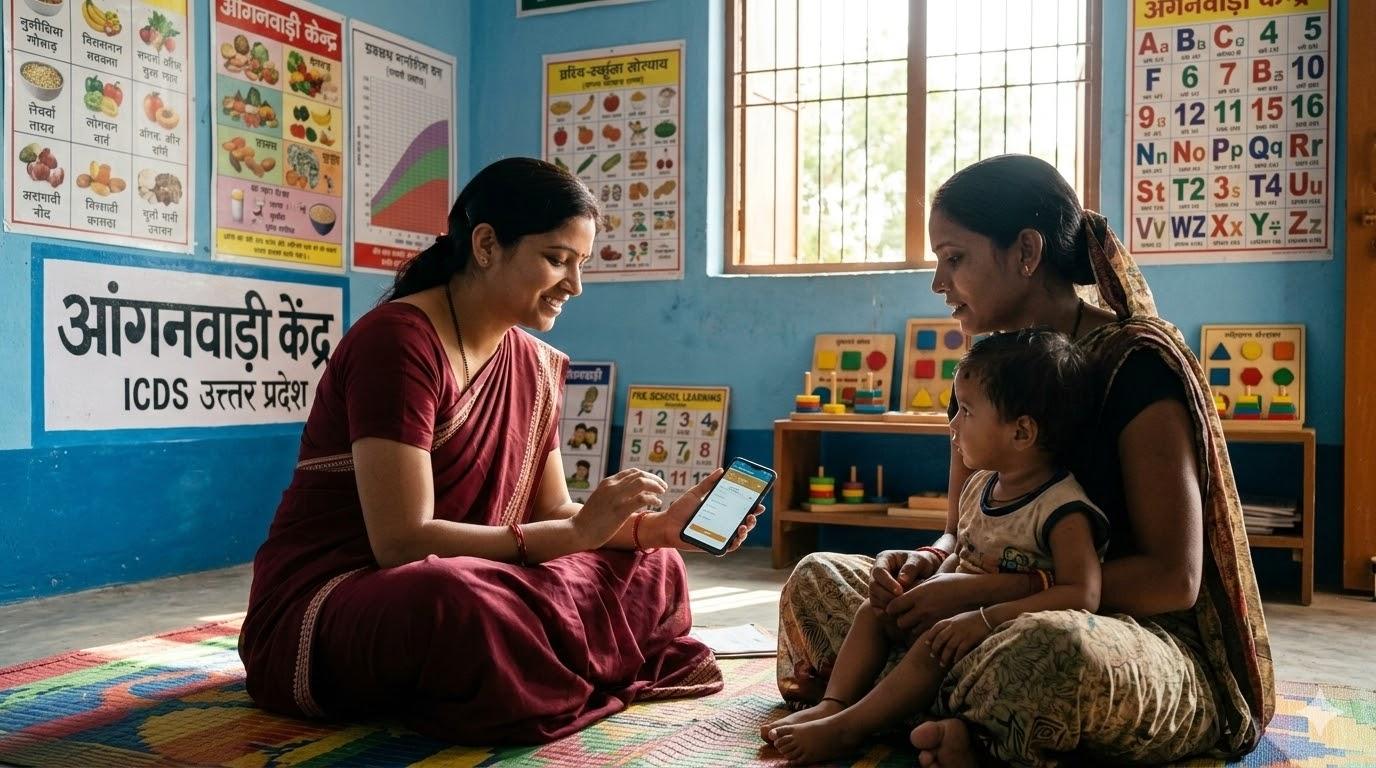
UP Govt ne Anganwadi Worker ke 60,656 posts ke liye recruitment jaari kar di hai. Agar aap 12th pass female candidate hain aur UP ke resident hain, toh bina exam ke merit base par selection paane ka yeh sunehra mauka hai. District-wise last dates aur online apply karne ka pura tarika yahan check karein.
The recruitment of Anganwadi Workers (AWW) and Anganwadi Helpers (AWH) in Uttar Pradesh for the 2026 fiscal cycle represents a transformative milestone in the state’s decentralized social welfare architecture. With an announced vacancy of 60,656 positions, this initiative is not merely a staffing exercise but a strategic deployment of human capital designed to facilitate the grassroots delivery of the Integrated Child Development Services (ICDS) scheme. This systematic expansion of the frontline workforce is orchestrated through a sophisticated digital governance framework, mandated by the Uttar Pradesh District Program Officer, and is deeply embedded in the "5T" vision—Tradition, Technology, Transparency, Trust, and Transformation—as articulated by the state’s leadership. The 2026 recruitment drive is a multi-dimensional intervention that addresses maternal health, early childhood education, and rural women's economic empowerment, functioning as a primary mechanism for achieving the objectives of a "Viksit Bharat" by the centenary of independence.
The administrative core of the 2026 recruitment cycle is characterized by a shift toward a highly structured, digitally mediated process. The transition from manual, local-level selections to a centralized online portal, upanganwadibharti.in, reflects an institutional commitment to eliminating bureaucratic leakages and ensuring a meritocratic onboarding process. This paradigm shift is supported by a backend infrastructure that utilizes advanced content management systems, including structured data templates for search engine optimization (SEO) to ensure that the recruitment notifications reach the most remote rural populations. The use of custom-built software for processing applications allows for real-time verification of candidate data, integrated with the e-District portal for the validation of residence, caste, and income certificates.
The governance model employed in 2026 decentralizes execution while maintaining state-level regulatory uniformity. The Uttar Pradesh District Program Officer serves as the nodal authority at the district level, tailoring the recruitment windows and vacancy distributions to the specific demographic needs of each jurisdiction. This "District Wise" strategy allows for granular control over the saturation of ICDS services, ensuring that high-need areas like Bahraich and Mirzapur receive a disproportionate allocation of resources to address historical developmental gaps.
Governance Feature | 2026 Specification and Mechanism |
Nodal Authority | ICDS Department, Uttar Pradesh District Program Officer |
Application Ecosystem | Centralized Digital Portal ( |
Technological Standard | 5T Framework (Tradition, Technology, Transparency, Trust, Transformation) |
Verification Logic | e-District Portal Integration for Certificate Validation |
Selection Philosophy | Academic Merit-Based (No Written Examination) |
The recruitment process as of March 2026 is operational across multiple geographic clusters, with application deadlines tailored to individual district readiness. The scale of the 60,656 positions is distributed across 75 districts, with recent updates highlighting active windows in several key regions. The staggered nature of these notifications allows the administrative backend to process the massive volume of data without compromising the integrity of the merit calculation or document verification stages.
The distribution of vacancies is a direct reflection of the "Village/Ward/Nyaya Panchayat" vacancy status. Districts like Bahraich, with 214 vacancies, and Mirzapur, with 159, represent significant regional hubs for recruitment, whereas others like Gorakhpur and Banda focus on smaller, targeted interventions to fill localized gaps in urban wards or remote villages. The extension of deadlines in certain districts, such as Mirzapur, indicates a responsive administrative approach to ensure maximum candidate participation in regions with high eligibility potential.
District Cluster | Role Type | Total Vacancies | Application Deadline |
Bahraich | Worker (Karyakatri) | 214 | 09 March 2026 |
Mirzapur | Worker (Karyakatri) | 159 | 09 March 2026 (Extended) |
Shamli | Worker (Karyakatri) | 57 | 08 March 2026 |
Gorakhpur | Worker (Karyakatri) | 15 | 08 March 2026 |
Banda | Worker (Karyakatri) | 11 | 28 March 2026 |
Saharanpur | Worker (Karyakatri) | 23 | 03 March 2026 (Recently Closed) |
Ballia | Worker (Karyakatri) | 13 | 27 February 2026 (Closed) |
Fatehpur | Worker (Karyakatri) | 25 | 21 February 2026 (Closed) |
In the preceding months, massive tranches of recruitment were concluded in districts such as Ghazipur (1,352 positions for Helpers) and Rae Bareli (1,034 positions), signaling that the 2026 cycle is part of a multi-phase mobilization of frontline workers that began in late 2025. The focus on specific roles—Anganwadi Worker vs. Anganwadi Helper—is determined by the existing staffing ratios and the specific needs of the mini-Anganwadi centers versus the main centers within each district.
A cornerstone of the 2026 recruitment policy is the elevation of the minimum educational requirement for Anganwadi Workers to the Intermediate (10+2) level. This shift from the previous matriculation standard is a strategic response to the increasing complexity of the role, which now includes digital data entry through the Poshan Tracker application and the delivery of early childhood care and education (ECCE) curricula. By mandating higher secondary education, the state ensures that the workers possess the cognitive and linguistic skills necessary for sophisticated community counseling and administrative reporting.
The demographic eligibility is strictly defined to foster women-led development at the community level. The recruitment is reserved exclusively for female candidates, emphasizing the role of Anganwadi centers as social safe-havens and centers for women's empowerment. The age profile for applicants is narrowed to a range of 18 to 35 years, with the cut-off date typically set to January 1, 2026, or July 1, 2025, as specified in the district-level advertisements. This age range captures a workforce that is energetic, capable of long-term community engagement, and technologically adaptable.
Eligibility Criterion | 2026 Specification and Standard |
Gender | Exclusively Female Candidates |
Education (Worker) | Intermediate (10+2) or Equivalent |
Education (Helper) | 12th Pass (Formerly 10th or 8th) |
Age Range | 18 Years (Min) to 35 Years (Max) |
Proof of Age | High School Marksheet/Certificate ONLY |
Residency | Permanent Resident of the specific Village/Ward/Panchayat |
The residency requirement, often referred to as the "Local Domicile Rule," is perhaps the most critical jurisdictional prerequisite. A candidate must be a permanent resident of the specific Village or Ward for which the vacancy is advertised. If no eligible candidate from the specified category is found within the Gram Sabha, the residency requirement may be expanded to the concerned Nyaya Panchayat. This ensures that the worker is a familiar figure in the community, facilitating the trust necessary for effective home visits and sensitive health counseling.
The 2026 recruitment cycle intentionally bypasses traditional written examinations to favor a transparent, academic-performance-based meritocracy. This approach minimizes the stress of competitive testing for a demographic that may have been out of the formal education system for several years while still rewarding consistent academic achievement. The selection is governed by a precise mathematical formula that standardizes marks across different educational boards and systems.
The merit list is compiled by aggregating scores from the High School, Intermediate, and Graduate levels. The fundamental calculation involves dividing the percentage of marks obtained in each qualifying examination by 10.
The calculation follows the scientific logic:
$$\text{Normalized Merit Score} = \frac{\text{Percentage of marks obtained}}{10}$$
For a candidate who secured $65\%$ in High School, $70\%$ in Intermediate, and $60\%$ in Graduation, the merit points would be:
High School Contribution: $\frac{65}{10} = 6.5$
Intermediate Contribution: $\frac{70}{10} = 7.0$
Graduation Contribution: $\frac{60}{10} = 6.0$
Composite Merit Score: $6.5 + 7.0 + 6.0 = 19.5$
This score is calculated up to three decimal points to ensure distinct rankings in highly competitive districts. In instances where candidates hold post-graduate degrees, their marks at the PG level are also factored into the final merit preparation, providing a significant competitive advantage to highly educated women seeking community-level leadership roles.
In scenarios where composite scores are identical, the administrative logic applies a sequential tie-breaking protocol:
Chronological Seniority: The older candidate is given priority.
Academic Superiority: If ages are identical, the candidate with the higher educational degree is ranked higher.
Vulnerability Weightage: Preference is extended to widows, divorcees, and women from families living Below the Poverty Line (BPL).
This system ensures that the selection process is not only meritocratic but also socially sensitive, prioritizing women who may be in greater need of economic stability through government honorariums.
The 2026 recruitment drive is supported by a robust fiscal framework, as reflected in the Uttar Pradesh state budget of ₹9.12 lakh crore, which represents a historic allocation for infrastructure, health, and social sectors. Within this budgetary envelope, significant reforms have been introduced to the honorarium structure of the frontline workforce. In February 2026, Chief Minister Yogi Adityanath announced a "historic" hike in the monthly payments for Anganwadi and ASHA workers, framed as a recognition of their pivotal role in the state's social stabilization.
Unlike regular government employees who are covered under the standard Pay Commission structures (including DA, HRA, and TA), Anganwadi positions operate on a fixed monthly honorarium model. This honorarium is a composite of the central government share, the state government share, and performance-linked incentives.
Position | Total Monthly Honorarium (2026) | Base Honorarium | State Top-Up/Incentives |
Anganwadi Worker | ₹8,000 | ₹4,500 | ₹1,500 (Base) + Performance Incentives |
Anganwadi Helper | ₹4,000 | ₹2,250 | ₹750 (Base) + Performance Incentives |
Mini-AWW | ₹6,000 | ₹3,500 | ₹2,500 (Composite) |
Supervisor | ₹29,200 | Pay Band 3 | Regular Scale Allowances |
The February 2026 hike introduced an additional ₹1,500 for workers and ₹750 for helpers, retroactive to September of the previous year in some contexts, but fully integrated into the 2026 disbursement cycle. This adjustment aims to bring the compensation in line with the inflationary pressures of the rural economy, ensuring that the role of an Anganwadi worker is seen as a viable livelihood rather than a purely voluntary service.
A major development in the 2026 policy is the universalization of health insurance for the Anganwadi workforce. All selected workers and helpers are now covered under the Ayushman Bharat Pradhan Mantri Jan Arogya Yojana, which provides an annual health cover of ₹5 lakh per family. Additionally, the workers are covered under the Pradhan Mantri Jeevan Jyoti Bima Yojana for life risk (₹2.00 lakh) and the Pradhan Mantri Suraksha Bima Yojana for accidental death or disability. These non-monetary benefits are essential for the long-term retention of the workforce, providing a safety net that was historically absent from the honorary model.
The duties of Anganwadi Workers in 2026 have evolved into a sophisticated blend of health monitoring, community organization, and early educational delivery. The worker is essentially the "first responder" of the state’s healthcare and nutrition infrastructure at the village level.
The Anganwadi Worker (AWW) is responsible for the systematic survey of all families within her jurisdiction to identify pregnant and lactating mothers. She facilitates their registration for the Pradhan Mantri Matru Vandana Yojana (PMMVY) and ensures they receive supplementary nutrition for at least 300 days a year. Furthermore, she acts as a liaison with the Auxiliary Nurse Midwife (ANM) to organize immunization sessions and health check-up camps, particularly for high-risk mothers and severely malnourished children.
The pre-school component of the ICDS is a primary duty of the AWW. Between 9:00 AM and 12:00 PM, she conducts non-formal education for children aged 3 to 6 years, following a prescribed syllabus that includes action songs, storytelling, and the use of indigenous toys to develop cognitive and motor skills. This early educational intervention is critical for preparing rural children for formal schooling, thereby addressing long-term literacy and education outcomes.
A defining feature of the 2026 role is digital proficiency. Every AWW is provided with a smartphone, through which she must maintain 24 distinct registers in digital format. This includes real-time growth monitoring (recording the weight and height of children every month), tracking the distribution of take-home rations (THR), and reporting on daily attendance. This digitization is intended to ensure "Transparency" and "Trust" in the distribution system, preventing the diversion of nutrition resources.
Responsibility Domain | Primary Tasks and Deliverables |
Community Survey | Annual mapping of all families, births, and deaths |
Nutrition Distribution | Planning menus based on local recipes for 300 days/year |
Growth Monitoring | Monthly weighing and plotting of growth cards for under-6s |
ECCE | Delivering 3-6 year old non-formal educational syllabus |
Home Visits | Daily counseling of mothers on breastfeeding and hygiene |
Health Liaison | Assisting ANMs in Pulse Polio and vaccination drives |
The Anganwadi Helper (AWH) supports these functions by maintaining the cleanliness of the center, cooking and serving supplementary nutrition, and collecting small children from their homes to ensure consistent attendance at the center.
The 2026 recruitment framework explicitly addresses the career aspirations of the frontline workforce by formalizing the promotion pathways. This is a critical component of the "Transformation" vision, turning honorary roles into a structured career ladder.
Under current administrative rules, 50% of the vacancies for Anganwadi Supervisors are reserved for promotion from the ranks of eligible Anganwadi Workers. The remaining 50% are filled through direct recruitment of graduates. For a worker to be eligible for promotion to the post of Supervisor, she must typically possess:
Minimum Service: 10 years of continuous, satisfactory service as an AWW.
Educational Advancement: Graduation from a recognized university is increasingly becoming a standard for the supervisory grade, although seniority-based lists for matriculate workers are also maintained for specific quotas.
Performance Record: Consistent compliance with digital reporting standards and high immunization/nutrition outcomes in her assigned village.
Supervisors act as the administrative middle-management, overseeing 20 to 25 Anganwadi centers each. They are responsible for consolidating the data from the Poshan Tracker, providing on-field guidance to AWWs, and ensuring that the CDPO (Child Development Project Officer) is informed of any localized health crises or supply chain interruptions. The move to the supervisor grade is a significant professional leap, involving a transition to a regular pay commission-based salary and broader administrative authority.
The 2026 recruitment process is as much a technological feat as it is an administrative one. The code architecture of the recruitment platform reveals a highly optimized environment designed for speed and user accessibility in low-bandwidth rural areas.
upanganwadibharti.inThe platform utilizes a TiptapEditor for high-fidelity content management, ensuring that district-wise notifications are rendered clearly on both mobile and desktop devices. The application form itself is managed through a state-driven React framework, with components like KVEditor and ChipSelect facilitating the easy entry of structured academic marks and personal details.
A critical feature of the recruitment backend is the runSeoAnalysis function, which ensures that every district notification is optimized for search engines. By targeting specific "Secondary Keywords" and maintaining a "Focus Keyword" (e.g., "UP Anganwadi Recruitment 2026 Bahraich"), the state ensures that when a potential candidate searches for jobs in her district, the official government portal is the first result. This is a strategic use of "Technology" to bridge the information gap in rural governance.
The platform enforces strict SEO standards for every post:
Meta Title and Description: Optimized to 60-155 characters to ensure clear snippets in search results.
Content Depth: Post templates mandate 500 to 1,000 words of descriptive text, explaining the "How to Apply" and "Eligibility" criteria in plain Hindi (Hinglish context) to improve E-E-A-T (Experience, Expertise, Authoritativeness, and Trustworthiness) metrics.
Digital Accessibility: The use of FileUpload components with size limits (5 MB) and specific MIME types (WebP, PDF) ensures that candidates with basic smartphones can upload their documents without needing high-end scanning equipment.
The 2026 Anganwadi recruitment is deeply intertwined with the broader socio-political narrative of the Uttar Pradesh government. Chief Minister Yogi Adityanath has consistently framed the expansion of these services as a movement from a "Fear Zone" (characterized by administrative neglect and communal unrest) to a "Faith Zone" (defined by the rule of law, festival economies, and women's safety).
The recruitment of over 60,000 women is the operational arm of "Mission Shakti," a state-wide campaign for the safety, dignity, and self-reliance of women. By providing a respectable honorarium and a public identity as a "Worker" rather than just a volunteer, the government is creating a new class of rural female influencers who are economically independent and politically active. This is further reinforced by programs like the "Kanya Sumangala Yojana," which provides ₹25,000 for a girl's education from birth to graduation, creating a pipeline of eligible, educated women for future Anganwadi cycles.
The implementation of the recruitment process serves as a proof-of-concept for the 5T model:
Tradition: Respecting local village structures and Nyaya Panchayats in residency rules.
Technology: Using the upanganwadibharti.in portal and smartphones for reporting.
Transparency: Adhering to the Academic Merit Formula ($\text{Marks}/10$) to prevent corruption.
Trust: Building a reliable workforce that the community can depend on for health and education.
Transformation: Converting a massive labor pool into a skilled social service workforce.
The 2026 Uttar Pradesh Anganwadi Worker Bharti Recruitment is a landmark event in the evolution of Indian decentralized governance. By integrating high educational standards, transparent meritocratic selection, and significant honorarium reforms within a sophisticated digital ecosystem, the state has set a new benchmark for community-based service delivery.
For the 60,656 women selected, these roles represent a critical pathway to economic stability and social leadership. For the millions of children and mothers served by these centers, the recruitment ensures the continued delivery of life-saving nutrition and developmental interventions. As the state moves toward its centenary goals, the Anganwadi workforce will remain the primary vehicle for ensuring that the benefits of India's economic growth reach the "last mile" of the rural population. The success of this 2026 cycle will ultimately be judged by the state's ability to maintain this fiscal and technological momentum, ensuring that the Anganwadi center remains a robust, trusted pillar of the village community.

UPSSSC has announced the UP Pollution Control Board Recruitment 2026 for 115 vacancies including Junior Engineer, Scientific Assistant, and Junior Assistant posts. Candidates with a valid PET 2025 score can apply online starting April 2, 2026.
HPRCA HP JBT Teacher Recruitment 2026 has been announced for 600 Junior Basic Teacher vacancies. Eligible candidates can apply online at hprca.hp.gov.in until April 6, 2026.
UPPSC Technical Education Principal Exam Date 2026 has been announced for 21 vacancies. Candidates can download their UPPSC Principal Admit Card 2026 from the official website using their registration details. Check the full schedule and exam day guidelines here.
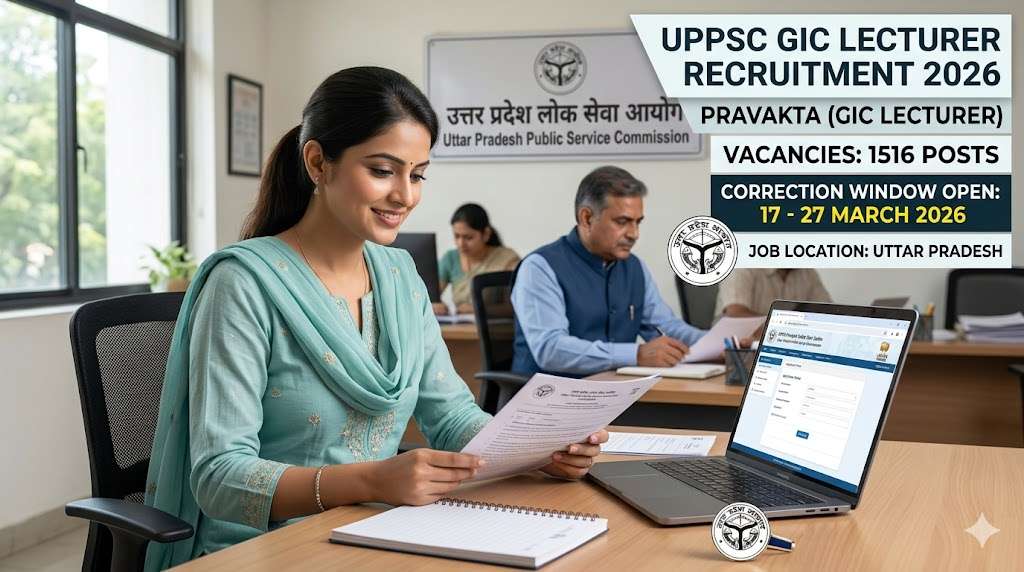
UPPSC GIC Lecturer Recruitment 2026: The correction window for 1516 Lecturer posts is now active. Candidates can modify their application forms from 17th to 27th March 2026. Check full details on eligibility, subjects, and selection process.

This guide is highly recommended for complete syllabus coverage.